Influenza Insights From the Pages of Literature

Influenza Insights From the Pages of Literature

Written by Kirsten Macdonald 

F. Scott Fitzgerald, Sherlock Holmes and Zombies piece together a picture of our culture, one that ravaged the world with the spanish flu over 100 years ago. 

A LETTER FROM F. SCOTT FITZGERALD, QUARANTINED IN 1920 IN THE SOUTH OF FRANCE DURING THE SPANISH INFLUENZA OUTBREAK.

Dearest Rosemary,

It was a limpid dreary day, hung as in a basket from a single dull star. I thank you for your letter. Outside, I perceive what may be a collection of fallen leaves tussling against a trash can. It rings like jazz to my ears. The streets are that empty. It seems as though the bulk of the city has retreated to their quarters, rightfully so. At this time, it seems very poignant to avoid all public spaces. Even the bars, as I told Hemingway, but to that, he punched me in the stomach, to which I asked if he had washed his hands. He hadn’t. He is much the denier, that one. Why, he considers the virus to be just influenza. I’m curious of his sources.

The officials have alerted us to ensure we have a month’s worth of necessities. Zelda and I have stocked up on red wine, whiskey, rum, vermouth, absinthe, white wine, sherry, gin, and lord, if we need it, brandy. Please pray for us.

You should see the square, oh, it is terrible. I weep for the damned eventualities this future brings. The long afternoons rolling forward slowly on the ever-slick bottomless highball. Z. says it’s no excuse to drink, but I just can’t seem to steady my hand. 

In the distance, from my brooding perch, the shoreline is cloaked in a dull haze where I can discern an unremitting penance that has been heading this way for a long, long while. And yet, amongst the cracked cloudline of an evening’s cast, I focus on a single strain of light, calling me forth to believe in a better morrow.

Faithfully yours,

Scott Fitzgerald

PS: I thought this would be a nice break from the news. Next week I will publish my perspectives on what we’ve all been through this week. N- this is a parody letter designed to lift your spirits care of this wicked fellow

The Great Gatsby by Scott f Fitzgerald available here. 

Walt Disney was 17 when he joined the Red Cross Ambulance Corps in September 1918. 

He came down with the flu while serving on the south side of Chicago. He returned home to be nursed back to health by his mother. Walt Disney survived it and went on to draw a famous mouse. 

   original print Mickey Mouse available here

Katherine Anne Porter is the iconic author of the short novel Pale Horse, Pale Rider and well known for a fictional account of the epidemic. Katherine herself became very ill with the flu and nearly died, her romantic interest at the time died from the same strain and set the sad interpretation and muse for Pale Horse. She is reported to say

“It (the flu) just simply divided my life, cut across it like that. So that everything before that was just getting ready, and after that I was in some strange way altered, ready.” 


Science journalist Laura Spinney’s book Pale Rider: The Spanish Flu of 1918 and How It Changed the World 

“It was a pandemic of influenza that struck in three waves. The first, mild wave in the Northern hemisphere’s spring of 1918 receded in the summer or late spring. A much more lethal second wave erupted in the latter part of August and receded towards the end of that year, and the third wave emerged in the early months of 1919.”  


She goes on to say “Russia was the first, followed by Western European nations, to put in place socialized healthcare systems. Along with that comes epidemiology, the search for patterns and causes and effects of patterns in healthcare and alternative medicine took off in a big way and spread around the world.”


Laura’s book available here

JAX Tyres for Ponderings

Historical literature expert  Susan F. Beegel is Editor of The Hemingway Review and an Associate Professor of English. 

Recently featured on a podcast, Susan mentions Hemingway likened the Spanish flu to war, a shocking way to go. The normally reductionist writer spoke gravely about the ‘battle.’ He lost family members to it. 

“My grandmother talked about going to work one day and working with a doctor, and coming in the very next day, and the doctor was dead. Before the pandemic burned itself out, it killed approximately 5 check . It killed more people than World War I itself, it claimed more lives than the Black Death of the Middle Ages in 100 years, and more people in 24 weeks than AIDS in its first 24 years. And most of these people were young people, or the majority of them, between the ages of 20 and 30 years old, and historians who study this say maybe killed between 8% to 10% of the world’s total population of people in this age group.” You can hear more of this podcast – click here 

Spiritualism took off in a big way after so many deaths. 

Sir Arthur Conan Doyle, the author of the Sherlock Holmes series, whose son and younger brother died of influenza was a big promoter of spiritualism. Doyle sold-out events discussing spiritualist ideas and showing “spirit photographs,” which claimed to show living people with the “ghosts” of dead family members standing behind them. 

Gregorios Xenopoulos October 1918 was a novelist, journalist and writer of plays from Zakynthos. He was lead editor in the magazine The Education of Children during the period from 1896 to 1948, during which time he was also the magazine’s main author. He wrote poetically about the flu as a Spanish woman. 

“As only if I could speak Spanish, I would be able to get on with this odd lady. The first thing that I would beg her would be not to invade so suddenly – she could understand me, if I could speak to her in her language. What a devil! Forty degrees of fever, suddenly, without any warning are not a joke! The invasion of forty crazy masqueraders in the saloon, during the carnival celebration, wouldn’t increase the temperature as much as the invasion of this lady. Despite the fact that ‘children’ of Andalusia are warm and lively, in a foreign place, they should behave in a distinctive way… I would also beg her not to stay for so long! Forty days visit is performed not by the Armenian, but by the Spanish lady… As for forty days, I couldn’t stand up on my legs, as during all these days I was obliged to entertain my crazy visitor… Hot drinks, quinine, suction cups, mustard plasters, foot washes, tonic regimes and so on… And as I didn’t know Spanish, I couldn’t even study, during the hours that Mrs. Influenza was letting me alone, the ‘Don Quixote’ from the original text!…’

Elizabeth Outka, associate professor of English at the University of Richmond says in her book Viral Modernism -The Influenza Pandemic and Interwar Literature; 

“Writers wrestled with the scope of mass death in the domestic sphere amid fears of wider social collapse. Overt treatments of the pandemic are seen in works by authors like Katherine Anne Porter and Thomas Wolfe and its subtle presence in works by Virginia Woolf, T. S. Eliot, and W. B. Yeats.” 

HP Lovecraft was said to be inspired to create Zombies with the Herbert West–Reanimator after the Spanish flu. 

One thing we must remember, society’s fear of a looming demise is as old as time itself. Pandemics are not unprecedented; we have been here before. During the Spanish flu, those in quarantine were lead to reflect, express and found ways and means of surviving, creating and breathing life into storytelling and art.

Right now, we are all living through an event our future children will learn about. What beauty will they be taught? How shall we inspire them? What will we change?

One thing will continue to raise us up; the joy of true faith, friendship, humour and as the great Mr Fitzgerald mentioned; red wine, whiskey, rum, gin, and lord, if you need it, brandy might help too. 

Written by

Related Articles

Related

Follow Us

Join

Subscribe For Updates & Offers

Support our mission to write and produce Positive Stortelling, it takes a tribe to build one. 

The Magic of Bees and The Beauty of Numbers in Nature

The Magic of Bees and The Beauty of Numbers in Nature

Written by Kirsten Macdonald

Why do bees buzz? What does maths have to do with sunflowers and the many beautiful fractal patterns of our world? 


A favourite book in our home held some wonderful clues to the mysteries of our hidden world. Critically acclaimed science-fiction author Ian Stewart is a British mathematician. He is Emeritus Professor of Mathematics at the University of Warwick, England. 

He has published more than 120 books, with an extensive list of impressive titles to wet your Harry Potteresque whistle, such as 

Professor Stewart’s Cabinet of Mathematical Curiosities

Why Beauty Is Truth: A History of Symmetry 

How to Cut a Cake: And Other Mathematical Conundrums- 

Professor Stewart’s Hoard of Mathematical Treasures

and he even has an award-winning app,  Incredible Numbers by Professor Ian Stewart

We are going to focus on The Beauty of Numbers in Nature.  Ian Stewart’s preface to his masterpiece is a touching genesis.


“When I was six, a friend showed me some curious little five-pointed stars that he had found on the beach…I became aware of a deep mystery: why does nature produce so many patterns?”

Stewart’s language maintains the mystery in the metrical, but the plurality of simple explanations and anecdotes make for fascinating reading. A feast for the mind that is anything but mundane; I would like to reflect on a selection of favourite chapters. 

Many shapes in our world typically look flat-faced in geometry. Not the spiral. 

Spiral Swirls 


“One of the favourite patterns of life, in fact, is based on curves- the spiral…Spiral shells appear way back in the fossil record, and one of the most common. The shell is formed by a soft bodied organism, for protection. As the creature’s size increases with age, it outgrows its existing chamber and builds an extension into its house.” 


Chambers and hidden secrets. It is no wonder Sir Terry Pratchett awarded Stewart Honorary Wizard of the Unseen University. 


“On land, snails build similar shells. Snail shells and indeed many seashells, often coil into the third dimension. Of course, the shape of the shells is always three dimensional: what I mean is that the “core of the spiral”, the line that runs along the centre of the chambers, ceases to lie in a plane and starts to curl into a third dimension of space.” 


I will never step on a garden snail again. An architect of a logarithmic spiral, powering into itself – not all it seems in our microworld. 


The Fibonacci Flowers


Fibonacci, the son of a custom’s officer, was a numbers man. His problem solving around rabbit populations in 1202 spawned mathematical patterns that would revolutionise thought. In basic terms; where after the first two numbers, each number is obtained by adding together the previous two numbers in the sequence. eg 1,1,2,3,5,8,13,21,34,55 – each number in the sequence is the sum of the previous two numbers. 

 Stewart observes: 

“Fibonacci numerology and spiral geometry are surprisingly common. They suggest that plant growth obeys simple but subtle mathematical rules, which lie somewhere in the interface between dynamics, geometry and arithmetic… Fibonacci numbers have penetrated deep into the mathematical psyche as an apparent endless source of inspiration and wonder…these numbers occur in the spiral structures many use to arrange their seeds. Fir cones are a good example. The scales on fir cones are typically arranged in two families of intertwined spirals, and each family contains a Fibonacci number of spirals…the seedhead of a sunflower displays these spirals in a gloriously regular pattern. Lillies have 3 petals; buttercups have 5, delphiniums often have 8, corn marigolds have 13, asters have 21.” 

photo: Ponderings Australia

Like your veggies? 

Stewart states:

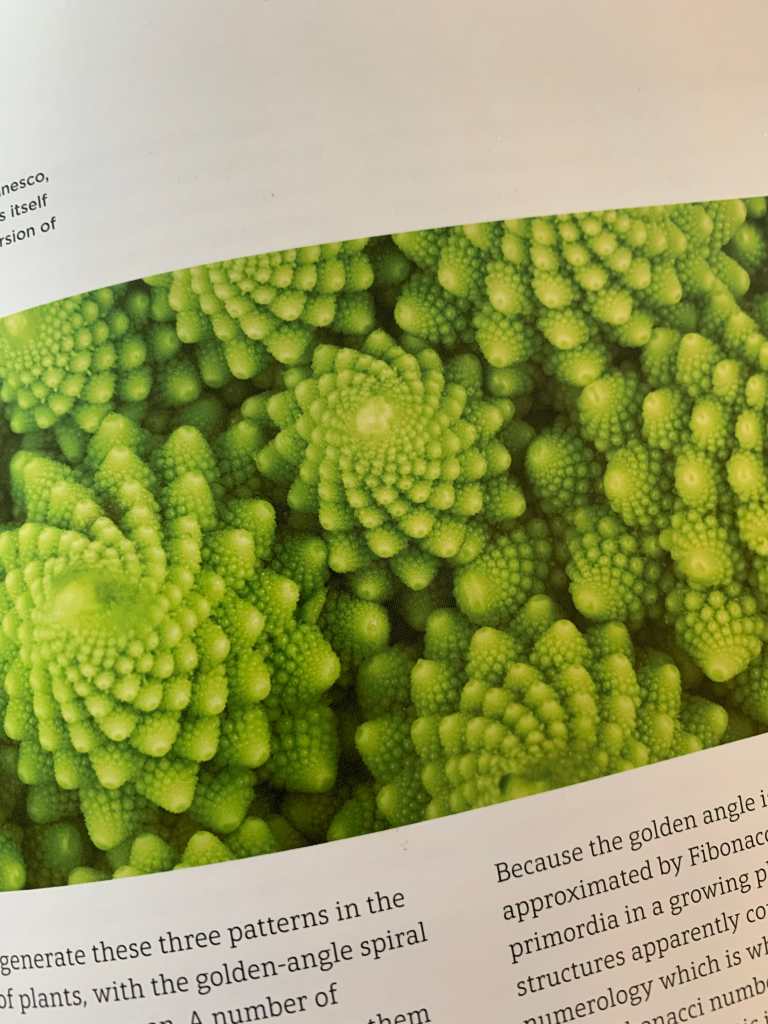
“The same numerology can also be seen in cauliflower, which we usually think of as featureless lumps of soft white tissue. On closer inspection, we find that the lumps are arrayed in beautiful spiral swirls. Sometimes the eye of a mathematician can see things that other eyes miss…Broccoli Romanesco, each unit of the spiral is itself a spiral, a miniature version of the entire plant.” 


photo credit; Ian Stewart The Beauty of Numbers in Nature

A golden angle is achieved with spiral growth which impacts things such a seed spacing, protection, growth and efficiency of survival. 


Ponderers we are consuming an intricate pattern of design, not just nutrients! The microcosmos in our backyards and onto our plates is extraordinary.


JAX Tyres for Ponderings

The Magic of Why A Bee Buzzes


“Most of what goes on when a creature flies is invisible to the eye because air is transparent. A bird in flight spins of a regular pattern of vortices, swirls of air spinning off from the trailing edges of its wings. The bird exploits these vortices to gain lift. Only recently have human engineers understood this particular trick, but the birds have known for a hundred million years.”

“We know how bees and other insects pull off their counterintuitive feat. Their wings move upward until they almost touch. When they beat downward, the sharp edge creates a leading-edge vortex. For reasons we don’t fully understand, this vortex remains ‘stuck’ to the top of the wing, generating lift, and spirals along it until it is shed at the wingtip. This method requires small wings that beat very rapidly, which is why bees buzz. And it’s why the flying pig will remain a metaphor for the incredible.” 

Don’t uyou wish we could see air in colour?


Fascinating world of fractals


“A Fractal is a geometric shape that has a fine structure no matter how much you magnify it…Nature’s fractals are extremely intricate, but they fuzz out on the atomic scale. A mathematician’s fractals are infinitely intricate and never fuzz out, no matter how closely you look.” 

“Rivers are trees of flowing water-the main river is like a trunk; its larger tributaries are branches, the tiny streams up the hills are the twigs. The water then ends in the river and erodes the land into fantastic treelike patterns. Our entire planet is a fractal. If you are a geologist.” 

The Beauty of Numbers in Nature is 223 pages, explaining every pattern imaginable, cascading into a presentation of deep philosophical questions about the foundations of physical law, the nature of space, time and matter, and the shape and history of the universe. Order in chaos, time travel and the realms of understanding is more than enough to nibble on. With beautiful pictures, this is the perfect coffee table book and will have you pondering. 

“When nature keeps reusing the same catalogue of patterns, the wise scientist pays attention.” – Ian Stewart

For those homeschooling, we have also sourced a wonderful list of resources to help kids explore science and the mico-world! 


https://www.mathsisfun.com/numbers/nature-golden-ratio-fibonacci.html

How Mathematicians Think About Patterns – Professor Ian Stewart

Fibonacci for kids 


Professor Ian Stewart is an active research mathematician with over 200 published papers, and currently works on pattern formation, chaos, network dynamics, and biomathematics. He lives in Coventry, UK, and is married (49 years and counting) with two sons, three grandchildren, and one great-grandchild. He is also a critically acclaimed science-fiction author. He has partnered on the award-winning Discworld series with Sir Terence (Terry) Pratchett OBE, an English author of fantasy novels, especially comical works. 


https://ianstewartjoat.weebly.com/biography.html


Related Articles

Related

Follow Us

Join

Subscribe For Updates & Offers

Support our mission to write and produce Positive Stortelling, it takes a tribe to build one. 

Dear Grownups

Dear Grownups

Words by Kirsten Macdonald

You are the humanity in which I am supposed to learn my way; to teach me your wisdom. 


You have walked the path, burned the forests, surely you have the knowledge, you have discovered a way forward you might teach me or might help reduce my pain and heal my trauma? 


For the trauma is supposed to be a lesson, not a prison. For the victim to become the warrior, will you hold the space with me? Teach me? Please don’t outsource your love and transcendence. I have waited so long. 


“All grown-ups were once children… but only few of them remember it.” 

― Antoine de Saint-Exupéry, The Little Prince


Don’t you want to heal your heart while you help me heal mine?


By the time I find these words, these big sounds you have taught me and I form them in ways to ask of you these things you have left. Your eyes glaze over, you have no time. This thing called time creates a gap in the footpath I cannot jump over. This crack cannot be avoided, it is a fault line that isn’t yours. 


You are doing the best you can. 


The only thing is I thought you had more. I was born with a promise you had more. More time, more love and calm. More peace and patience. I want. Why was I born with this promise inside me? This expectation? It feels unkind, an empty box on a day of gifts. 


The guilt unfurls like ripped ribbon and I am starting to understand now. 


This is the way of things. I shall snap these twigs between my thighs and start a fire, because you have taught me well and these things shall pass. 


We shall stamp our feet on the earth, watch the dust fly up, saltwater, tear the leaves, sing into the wonder of night and laugh in the rebirth of the morning. I shall love you, bathe your feet and know you as best I can. For the box was never empty, it was never a box at all, it was a message that said I am so tired my child. 

“Grown-ups never understand anything by themselves, and it is tiresome for children to be always and forever explaining things to them” 

Antoine de Saint-Exupéry, The Little Prince

Written by

Related Articles

Related

Follow Us

Join

Subscribe For Updates & Offers

Support our mission to write and produce Positive Stortelling, it takes a tribe to build one. 

The Tangible Oscillation of Us

The Tangible Oscillation of Us

Words by Kirsten Macdonald


This earth spins, and its inhabitants live in a systemised structure designed to keep us animated. 


To keep the axis infused with purpose. Functionalized pecking order is not reserved for the human species either; most species have hierarchical structures. From Zebrafish to Lemurs, many of earth’s inhabitants distribute resources by way of categorising classes. Birds and fish do not let their own starve, but then wolves will eat their young… there’s that. 


It’s the social stratification stuff that gets interesting. Samurai to Servant, Bourgeoisie to Butler, Brahmins to Shudras, we could go on for days. Words like Third World, lower socio-economic, middle class, uneducated, academic, wealth, poverty, powerful words all based around how products, food and energy is distributed. 

Civilisation has us transformed from tribes to towns and towns to towers. 

To feed the world, we are told we must control the soil, grow more, make the seeds more robust, use science to control the soil, so it absorbs the moisture, kills the bugs and then we kill the nutrients. So then we buy the supplements we need because the food does not give it to us. We try to stop starvation, and we swallow disease for the privilege. There are even classes and equipment we can pay to do the exercise we would have done collecting water and making bricks or our growing food. A little ironic and chaotic don’t’ you think?

But the uncanny thing is we can change the pattern, and we have everything at our fingertips. 

Physics tells us we can. Let’s make a quantum leap here. 

Life is a label we give to animated cells. 


Do we store our wisdom, our ancestral memory in our brain, our DNA, or in our ether or is it a binary system, a code written well before primordial sludge could swipe an EFTPOS card? Can existential lessons create a version of social inertial force? Imagine if we imbued these structures with a new form?


Have you ever heard of the theory of Spontaneous Self-Organisation? Universal and very complex phenomena are taking place in the physical, chemical and biological world, and it is science’s way of understanding unexplainable order in the chaos. 


Everything vibrates or moves; even inanimate objects are made of tiny particles. Here is where it gets interesting; when different vibrating forms are near each other; they will often start to vibrate together and get in sync with each other. Welcome to Spontaneous Self-Organisation.  


An example is the patterned swimming of schools of fish, without any outside direction. 


When many fireflies get together, their light will begin to pulsate at the same rate. Crystallisation and snowflake patterns are another. There are so many. Scientists are now working out how DNA does this, along with stem cells along with neuroplasticity. It’s exciting, and it is complicated. 


Magnets are an excellent example of SSO. 


Iron is a magnetic material and is made up of tiny magnets called ‘spins.’ Each spin will point in different directions, and their magnetic fields will cancel each other out. There is no order. If the temperature goes up, the more random. But when the temperature decreases, the spins will spontaneously align themselves, so that they all point in the same direction. Instead of cancelling each other, the different magnetic fields now add up, producing a strong overall field. 


But here’s the clincher, with spontaneous self-organisation there has to be disorder first for new random fluctuations to emerge. A dynamic state between order and chaos emerges otherwise called “The Edge of Chaos?” Only when chaos builds to a large point can a weak fluctuation be amplified to create a new pattern. 


If we are made of cells in animation, experiencing ‘life” then surely we must be a ‘life force.” 

JAX Tyres for Ponderings

When we endeavour can we align spontaneously with each other? What about consciousness? Is this a shared resonance? I don’ t know about you, but there’s a whole lot of chaos on planet earth right now. 

Is this life simulation or an echo bouncing back at us? 

Is it not the stars that shine brightly or us reflecting from them? 

Is this spontaneous self-organisation a science theory about to be proven, or is there a frequency of divinity that is not an external force understood of old but one mighty universe from within? 

Wouldn’t it be a cosmic kind of sonic bang if we aligned and were no longer controlled by genetically modified consumerism and started a new pattern?


Fish swim, fireflies light. What if human’s ‘kinded?’ If every single action is with kindness, then maybe with a little quantum physics, spin and a dash of positive loop feedback, we can evolve and change some of those class ideas while we are at it. 


We are like litmus paper; if we are slowed will we finally be ready to absorb the wisdom that comes in waves from our ancestors? Do we know how? 


One can only ponder. 


References for further reading;

http://assets.press.princeton.edu/chapters/s7104.pdf


https://www.youtube.com/watch?v=3ypBqxv_tz8


http://www.freshvista.com/2014/natures-self-organizing-patterns/


https://systemsinnovation.io/self-organization-overview-articles/ 

https://www.nature.com/articles/s41598-019-46104-z


(http://134.184.131.111/SELFOREX.html)  


Written by

Related Articles

Related

Follow Us

Join

Subscribe For Updates & Offers

Support our mission to write and produce Positive Stortelling, it takes a tribe to build one. 

Shapeshifters, Hairy Dancers and Things That Go Bump in The Night

Shapeshifters, Hairy Dancers and Things That Go Bump in The Night

The Myths, The Magical and Mysterious


words by Kirsten Macdonald 


Our modern-day screens are overwhelmed with creepy blood-curdling monsters.  


These frequently overtly sexualised characters who morph into werewolves and vampires, sirens singing sailors to their deaths or the deep blue seas. Supernaturally charged, they have evolved from the village fireside precautionary tales and spins of old to the pop culture halls of fame. 


Have you read the original Grimm brothers Fairy tales? I studied them at University at they are not for the faint of heart. Don’t even get me started on Little Red riding hood, because that story isn’t what you think it is…


But what about the monsters lurking around the world who haven’t had much love? Let’s give these ghastly Villians some attention! Mind you, after you are well informed, you may understand why they are not so popular, they’re not the kind you want to bring home to Mum. 


The Näkki


In Finnish mythology, a Näkki (Estonian: Näkk) is a Neck. This shape-shifting water spirit usually appears in human form, residing in darkened pools, wells, docks, piers and under bridges.


Notorious for yanking young children down into the depths, it is advised for our young ones not to look into the water or lean into the depths. 


Nordic mythology tells us Midsummer’s night is when Näkki rises from the water to dance with people celebrating. BEAutiful to look at from the front, their back is bewhiskered and uncomely. 


Näkki is also called Vetehinen or Vesihiisi (water fey, see Hiisi).


Ponderings PHoto monsters NAakti

Nunyunuwi The Stone Man


Known to the Cherokee nation; the Stone Man or Nunyunuwi is a shuddersome character. 

A wicked cannibal, this flesh-eater prefers hunters for meals and takes on the disguise of an old man wearing a stone coat. Stories tell of his defeat and rising. There are many variations, but in all, he is dyspathetic when it comes to menstruating women. At that ‘time of the month, women became powerful allies in warding off the Stone monster and his enormous hunger for human flesh. 


Cuca   


From Brazilian folklore, Cuca is a diabolical female monster. She is a hideous witch, with some age, and who has an alligator head. Cuca kidnaps the naughty children who won’t go to sleep. She is a curmudgeonly and hellish hag that will commit evil deeds to those who don’t snooze: terrifying little ones everywhere and a fearsome ally to parents all over Brazil. Close your eyes, children! 


Although Cuca came from the Portuguese coca, in Tupi (an indigenous language of Brazil), Cuca means to swallow something with a single gulp.

Yikes. 


photo credit Real World Fatos

photo credit Real World Fatos

JAX Tyres for Ponderings

Grýla 


Iceland has its own Ogre, and it isn’t a green loveable Dreamworks character.   Grýla is a terrorizing giantess who dwells in the mountains of Iceland. She wears a prickly and hairy chin, has eyes in the back of her head and has a pet Christmas cat, a fearsome creature who eats people who don’t get clothes for Christmas. 


Again a tale told to frighten children (poor kids, really parents!) Gryla is known for her keen hearing, and she can smell a child from miles away. She too has a hankering for human flesh, particularly that of wicked children. She stores them away for a Christmas stew. She was so awful that in 1746 public decree prohibited parents from traumatising their kids with the tale any longer. Thank the heavens. This one is dreadful. 


Picture: Brian Pilkington from the book The Yule Lads

Picture: Brian Pilkington from the book The Yule Lads

Draugen

Draugen is the sinister ghost of a man who died at sea terrifying Norweigiens. He is behemothic, coated in seaweed, and rows in half a boat. DRaugen’s trademark is an ear-piercing scream to announce his arrival, and he likes drowning sailors and those who want to fish. 


Weapons do not defeat him, only a warrior can wrestle him back to his gruesome cave, and this fiendish ghoul can enter the dreams of the living along with shapeshifting and future telling. According to the Function of the Living Dead in Medieval Norse and Celtic Literature, the mottled man is intelligent to boot; this Old Norse monster was undoubtedly worth a mention. 

listversepicturecredit

photo credit listverse pictures

The Capitalismus


Finally we have the last one- the nastiest of them all- The Capitalismus. 

A fire breathing monstrous beast, this one devours Brazillian rainforests with licks of fire, riding large mechanical beasts and filling it’s belly with the fear of the people. A terrifying traveller, this fiend travels the globe seeking victims. Often seen as attractive and seductive, the Capitalismus cloaks itself in badges of honour and munches on sea dwellers, driving them out of their homes and lands. Particularly shifty, this insidious trickster is very troll like and keeps dungeons of gold and silver tucked away. Not for the faint, this monster can only be defeated by the bravery of those who believe in equality and protecting the tribes with truth and honour. 


You can read more about them here: https://www.britannica.com/topic/capitalism 


credit photo Alexas Fotos Ponderings monsters

photo credit  Alexas Fotos


References and important notes for our Ponderers


The Cherokee Nation is a sovereign tribal government. Upon settling in Indian Territory (present-day Oklahoma) after the Indian Removal Act, the Cherokee people established a new government in what is now the city of Tahlequah, Oklahoma. A constitution was adopted on September 6, 1839, 68 years before Oklahoma’s statehood. 

https://www.cherokee.org


The Sami are the indigenous peoples of the northern part of the Scandinavian Peninsula and much of the Kola Peninsula, and live in Sweden, Norway, Finland and Russia. It is estimated that they represent between 50,000 and 100,000.


https://www.iwgia.org/en/sapmi.html


The Unknown Lore of Amexem’s Indigenous People: An Aboriginal Treatise


https://www.firstpeople.us/FP-Html-Legends/NunyunuwiTheStoneMan-Cherokee.html


http://nativeamericanantiquity.blogspot.com/2013/05/cherokee-witchcraft-conquering-stone.html


https://blogs.transparent.com/portuguese/the-legend-of-the-cuca/


https://guidetoiceland.is/connect-with-locals/regina/gryla-and-leppaludi-the-parents-of-the-icelandic-yule-lads


http://wayback.vefsafn.is/wayback/20130122160640/http://icelandreview.com/icelandreview/search/news/Default.asp?ew_0_a_id=317411


http://www.thjodminjasafn.is/jol/adrar-vaettir/nr/2983


https://izi.travel/en/b530-creatures-of-norwegian-mythology/en


The function of the living dead in medieval Norse and Celtic literature: death and desire. Lewiston, New York: Edwin Mellen Press. 


Nordisk familjebok Linköping University


Old Norse: Draugr, plural draugar; modern Icelandic: draugur, Faroese: dreygur and Danish, Swedish, and Norwegian: draug) is an undead creature from Norse mythology, also called aptrganga or aptrgangr, literally “again-walker” (Icelandic: afturganga).


https://www.nationalgeographic.com/history/2020/04/in-brazil-indigenous-people-fighting-to-keep-children/


https://www.hs.fi/english/article/Uncovering+the+secrets+of+the+Sámi/1135218761063/


Written by

Related Articles

Related

Follow Us

Join

Subscribe For Updates & Offers

Support our mission to write and produce Positive Stortelling, it takes a tribe to build one. 

Look at Moi, Look at Moi, Look at Moi

Look at Moi, Look at Moi, Look at Moi

Words by Cassidy Krygger


“Now I’ve got one word to say to you… ” 


There is a bit of Kath and Kim in all of us, and the iconic Aussie comedy series has fans all over the world even though it is uniquely Australian. 


Watching it is like putting on your favourite pair of ugg boots that are comfortable and familiar. And nearly 20 years after it was first released, the foxy morons from Fountain Lakes are still as popular as ever. So what is the secret behind the lasting success of Kath and Kim?


Kath and Kim follow the life of the always well presented and accessorised Kath, her only daughter, the slovenly Kim, their husbands Kel (Glenn Robbins) and Brett (Peter Rowsthorn) and Kim’s second-best friend Sharon (Magda Szubanski).


Created by Gina Riley and Jane Turner; the characters of Kath and Kim blossomed from the mid-90s in the comedy series Big Girls’ Blouse. 


The Head of Drama at the ABC in the early 2000s championed the idea of a full series, giving the show the unique distinction of being a comedy produced by the drama department. It lasted four seasons, with a telemovie and a feature film before being rested by Riley and Turner in 2012. 


Kath and Kim, along with Kel, Brett and Sharon have the unique capability of being loved by the people they are parodying. There is somebody in all of our lives who is just like them, or perhaps we can see a bit of the characters in ourselves. It’s unique Australian humour with references to the day to day life that we are all familiar with. But Kath and Kim also have International appeal with some big names making guest appearances including Kylie Minogue, Matt Lucas, Barry Humphries, Geoffrey Rush and Michael Buble. It also produced a short-lived American spinoff starring Selma Blair and Molly Shannon in 2008; cancelled after only one season. 

So, just how does Kath and Kim stand the test of time?


 I asked the question to over 60,000 members of the Facebook group ‘Da Kath and Kim Appreciation Society’ and received many interesting answers. 


The common theme? 


The show is familiar, funny and comfortable. 


It feels like you are visiting old friends every time you watch it. 


For me, whenever I watch it, I am instantly transported back to my childhood in the 2000s. 


And of course, the hilarious phrases and words that they use. 


Kath and Kim have inspired many quotes that have become a part of everyday Aussie vocabulary.


My top 5 favourite quotes:


“Does it make me a crim to keep myself trim?” – Kath


“I’m not criticizing you mum. I’m just saying you look bad.” – Kim


“No kiss. No coach.” – Brain (played by Tony Rickards)


“Things to see, people to do.” – Gary Poole (played by Mick Molloy)


“It’s noice. It’s different. It’s unusual.” – Kath and Kim


Kath and Kim is currently streaming on Netflix. If you are a BIG FAN and want to test your knowledge; check out the quiz from their website- https://kathandkim.com/kath-kim-quiz/


https://www.theguardian.com/tv-and-radio/2020/jan/18/how-kath-kim-became-style-icons-wed-end-up-in-tears-on-the-floor


https://www.facebook.com/groups/2205140465


https://www.nine.com.au/entertainment/latest/kath-and-kim-great-australian-comedy-reasons-nine-watch/95c2ab3b-c5c6-46c9-887d-1226bbc92f10

JAX Tyres for Ponderings

Related Articles

Related

Follow Us

Join

Subscribe For Updates & Offers

Support our mission to write and produce Positive Stortelling, it takes a tribe to build one.